
Constellation · Nevv Capital
Beauty, Scarcity, Story: The Value Trilogy
In every era, and across every culture, the objects that endure, the ones that are treasured, traded, inherited, and fought over, share a quiet architecture of worth built on three forces: beauty, scarcity, and story. Beauty captures the eye; scarcity anchors the market; story turns an object into a legacy.
Fine jewellery sits precisely at this intersection, where materials become meaning and meaning becomes value. Long before jewels were placed in vitrines or photographed under museum lights, humans were already converting their wealth into things meant to outlast them. Fine jewellery began not as luxury, but as logic; a practical, portable form of preservation in a world where empires burned, rulers changed, and fortunes were vulnerable.
The earliest civilisations understood one thing very clearly: value that moves with you survives. Gold became the first hedge against uncertainty. Stones became the earliest form of cultural memory. A bracelet was a contract. A necklace, a safety deposit box. A ring, a sovereign signature. Across millennia, jewellery functioned as one of the early alternative assets, liquid, durable, borderless, and legible across languages and lineages.
And nowhere is this trinity more visible, more disciplined, and more irresistibly compelling than in the world of Cartier.
From Survival to Sovereignty
As kingdoms grew, jewellery shifted from protection to power. Mughal courts commissioned emeralds carved into leaves, rubies the colour of flame, diamonds the size of plums. Hellenistic kings wore gemstones on armour as declarations of dominion. European monarchs built treasuries in enamel, pearls, and gold, wearable architecture engineered to communicate legitimacy.
Commissioning jewellery became a form of statecraft, a diplomatic language in metal and light.
The Moment Craft Became Culture
By the Renaissance and Enlightenment, goldsmiths evolved from artisans into intellectuals of form. They wove mathematics, symbolism, botany, and astronomy into settings and hinges. Families commissioned pieces not to adorn the present but to shape the future. Jewellery became a means of continuity, a vessel for identity and inheritance.
By the 19th century, fine jewellery had become the closest thing Europe had to a formal wealth-transfer mechanism. A brooch was capital. A tiara was a treasury. A wedding gift was a long-term allocation. Every generation added emotional interest and monetary appreciation. A family didn’t just own jewels, it held positions in the market of beauty, status, and memory.
This was jewellery’s full metamorphosis, from ornament to intergenerational asset class.
The Cartier Chapter
Into this thousand-year lineage stepped the great maisons, Fabergé, Boucheron, Tiffany, Van Cleef, and Cartier in 1847.
But Cartier’s genius was never merely technical. It was conceptual. Where previous centuries produced masterpieces, Cartier produced archives, signatures, design codes, provenance logic, a philosophy of proportion, and a global clientele that spanned monarchies, heiresses, maharajas, film stars, and dynasties.
Cartier understood earlier than most that. Value is not in the stone. Value is in the story the stone is allowed to tell. And so the maison began shaping not just jewellery, but the very architecture of long-term value.
Time, Stones & Storytelling: At the V&A Exhibition
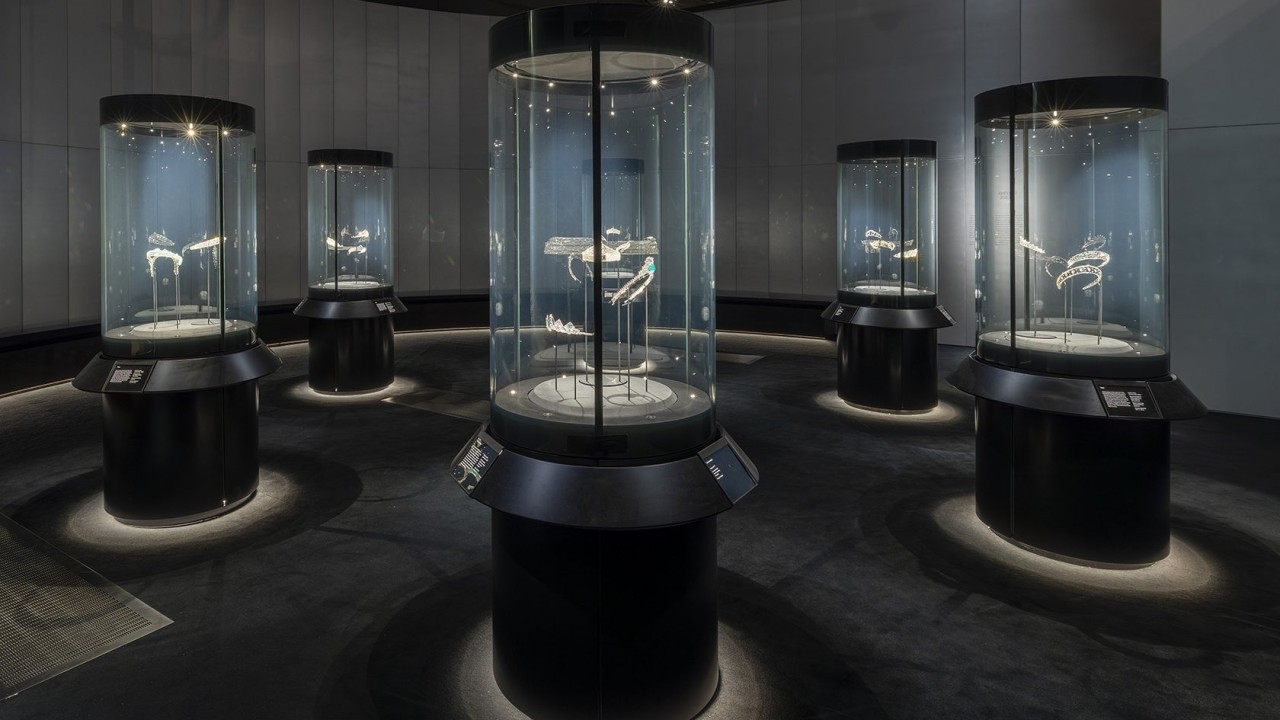
Stepping into the V&A’s Cartier exhibition was like entering a chamber of concentrated time. Light changes. Colours sharpen. The world softens into silence.
In vitrines sit pieces that behave less like jewels and more like testaments for how value is built, held, and transferred.
Curated by Helen Molesworth and jewellery editor Rachel Garrahan, the exhibition unfolds within a space conceived by British designer Asif Khan, a design that feels less like a museum layout and more like an environment you enter. Khan has described his aim as creating a setting that moves between eras, senses, and cultures, and that idea is palpable throughout. Pieces appear to float within soft, shifting textures of light and sound, giving each object room to breathe. The pacing of the rooms, the quiet glow of the vitrines, and the gentle transitions between spaces create an atmosphere that slows you down, inviting you not just to look at the jewellery, but fully take in the artistry of what’s on display.
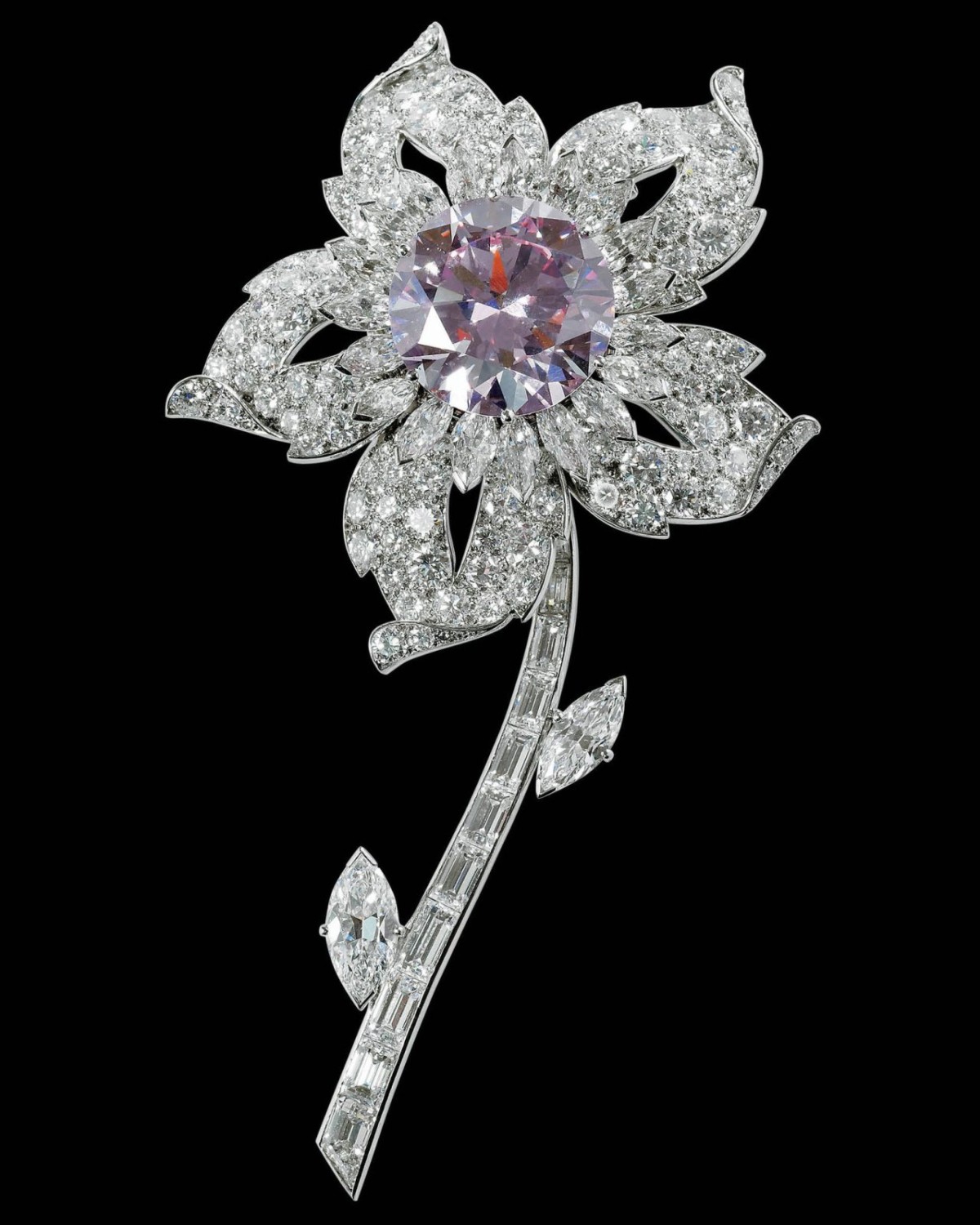
The Williamson Pink Diamond Brooch, a famous royal jewel featuring a 23.6-carat pink diamond, given to Queen Elizabeth II as a wedding gift by Canadian geologist John Williamson. Cartier created the brooch in 1953, designing it as a platinum and diamond jonquil flower to showcase the central pink stone. The final design was a collaboration between the Queen and Cartier, with Queen Elizabeth II approving several design paintings before production.
Princess Margaret’s rose brooch, a coronation witness, shows how narrative compounds like yield. Grace Kelly’s emerald-cut diamond ring reveals the alchemy where culture, marriage, cinema, and monarchy converge. The Scroll Tiara, ablaze with 1,040 diamonds, shows how abundance becomes coherence in the hands of a disciplined maison.
Provenance as Yield: The Economics Behind the Sparkle
In finance, story is often treated as a soft factor. In high jewellery, it is a structural force. A gemstone becomes valuable through geology. A Cartier piece becomes valuable through context: who commissioned it, who wore it, what moment it witnessed, what archive holds its original sketch.
This narrative isn’t embellishment, it is economic infrastructure. It multiplies demand, elevates liquidity, and creates asymmetric upside similar to fine art.
Throughout the exhibition, it becomes clear how profoundly Cartier’s clients influenced the evolution of its designs. Many creations were commissioned for specific individuals, and that personal intention still echoes through the pieces. Looking into the cases, you’re not simply encountering objects, you’re meeting fragments of lives, moments, and eras. Each jewel feels like a small portal into another world, much like lifting the lid of one of Cartier’s red boxes and finding a story crafted in metal and light.
The Modern Collector: Taste as Capital
Today’s jewellery collectors resemble CIOs more than socialites. They analyse auction records, track design eras, understand atelier signatures, and allocate across decades with the precision of asset managers.
High jewellery has become a mature market; transparent, data-rich, culturally resilient, and globally liquid.
Cartier sits at its centre, not because its pieces are expensive, but because its philosophy is consistent. A Cartier signature is a guarantee of proportion, restraint, craftsmanship, and narrative coherence, the four qualities that define long-term value in any asset class.
Food for Thought
As you leave the exhibition, a final glint catches your eye, a clasp, a setting, a diamond cut so clean it feels illuminated from within.
And the realisation settles: Jewellery is not precious because it is beautiful. It is precious because it holds the value for generations. It bridges the ancient and the modern, the personal and the ancestral, the emotional and the economic.
Most assets rise with cycles. Some with scarcity. A few with fashion. But only a rare class of objects rises with time itself. Fine jewellery doesn’t try to outrun time; it invites time to accumulate around it. Cartier merely perfected the language.
At Nevv, we curate legacies. Our strategy sits at the intersection of these exclusive worlds, giving sophisticated investors the tools, insights, and access to participate intelligently in the alternative assets universe.*
DM or WhatsApp us to learn more.*
*For professional and accredited investors only!
Disclaimer: This analysis is provided for informational purposes only and should not be considered as personalised investment advice. Past performance does not guarantee future results. Investors should consult qualified professionals before making any investment decisions.