
Constellation · Nevv Capital
Private Markets Were Private For A Reason

In the late 1860s, a civil engineer named John A. Roebling began designing a bridge that would connect Manhattan to Brooklyn across the East River. No bridge had ever spanned that distance. No one had ever used steel cables at that scale. Roebling died before construction began. His son took over and was incapacitated midway through. His wife Emily, who had taught herself structural engineering from scratch, completed the project. On May 24, 1883, she became the first person to cross it.
The Brooklyn Bridge took more than a decade to complete. At every stage, it was one of the most technically demanding structures of its era. The public who eventually crossed it had no idea what the caissons beneath the East River had required: the pressure, the risk, the workers who died. They just crossed the bridge.
2026 Is The Year of Alts
Private markets are undergoing their own infrastructure moment in 2026. The bridges are being built. The bells are being rung. And in the rush of access and enthusiasm, it is worth pausing to ask a question that the original architects of private markets would have considered obvious: is everyone who wants to cross this bridge ready for what is on the other side?
The democratisation of private markets is one of the defining stories of the year. The acquisitions are real. The White House has issued an executive order intended to allow 401(k) investors to access alternative assets, potentially affecting more than 90 million Americans in employer-sponsored defined-contribution plans. Robinhood has listed a closed-end fund on the NYSE, though it is not the first to try. But before the rush becomes a stampede, it is worth remembering what the original gatekeepers understood, and what the new generation of platforms has not yet had to learn.
ACT I · The Infrastructure Moment
How Washington Opened The Door and Wall Street Walked Straight Through It
There are moments in any industry's history where the narrative shifts from the headline product to the infrastructure beneath it. In the late 1990s, beneath the dot-com spectacle, companies like Akamai, Cisco and Verisign were quietly building the backbone that the entire digital economy would eventually depend on. The dot-coms crashed. The infrastructure endured.
Private markets are having that moment now. And it began not on Wall Street, but in Washington.
The White House Signed an Executive Order
On August 7, 2025, President Trump signed Executive Order 14330, titled, with characteristic directness, "Democratizing Access to Alternative Assets for 401(k) Investors", directing the Department of Labor to to revisit the regulatory barriers preventing retirement plans from including broader exposure to private equity, private credit, real estate, and digital assets.
The DOL moved with unusual speed. Within five days, on August 12, it rescinded its Biden-era guidance that had discouraged plan fiduciaries from including private equity in 401(k) fund menus. The guidance had argued that many plan fiduciaries lacked the experience to evaluate private equity instruments. In the DOL’s new view, that guidance had created a chilling effect on the market. It was withdrawn within the week.
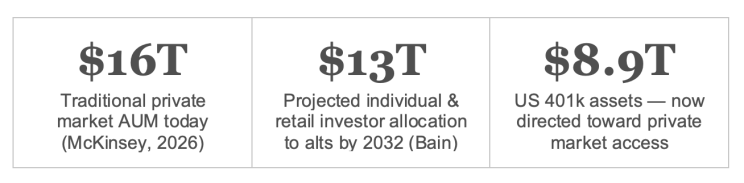
The scale of what this may unlock is difficult to overstate. Americans collectively hold $8.9 trillion in 401(k) assets, and more than 90 million Americans participate in employer-sponsored defined-contribution plans. Even a modest allocation to alternative investments would represent a significant new pool of capital flowing into private markets from a channel that has historically remained largely inaccessible. BlackRock, Apollo, and Empower are already building the vehicles. The regulatory path is becoming clearer. The distribution machinery is already in motion.
Wall Street had been watching. It did not hesitate.
Then The Incumbents Moved
Within weeks in late 2025, with the regulatory path now clearer, three of the most consequential moves in retail private-market distribution were announced. These platforms were not chasing a trend. They already had the clients, the relationships, and the attention. The only thing missing was access to the product suite, and three acquisitions moved quickly to close that gap.
The acquisitions of Forge, EquityZen, and Industry Ventures confirmed what anyone watching already suspected: incumbent distribution is the new frontier of alternatives.
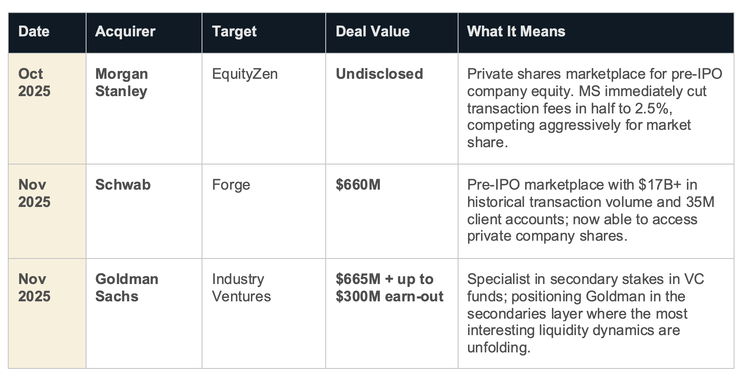
The logic behind each acquisition was the same: the largest financial platforms in the world had decided that private markets were a core revenue and client-retention opportunity, not an optional add-on. Schwab CEO Rick Wurster said it plainly when announcing the Forge acquisition: companies are staying private longer, and providing direct access to clients makes sense. EquityZen founder and CEO Atish Davda was equally direct: the vast majority of even wealthy clients still have no private-market allocation at all.
These institutions are not philanthropists. They are building infrastructure because there is an estimated $13 trillion in private wealth expected to flow into alternative assets by 2032. The bridge is being built because the returns on the other side are extraordinary, and because Washington just handed them the planning permission.
ACT II · The Experiment
Two Funds, Two Years Apart, and The Same Structural Lesson
On March 6, 2026, Vlad Tenev rang the opening bell at the New York Stock Exchange to launch Robinhood Ventures Fund I (NYSE: RVI).
RVI is not the first attempt to give retail investors a listed public wrapper around private company assets. To understand what happened on March 6, 2026, it helps to understand what happened on March 26, 2024. That was the day Destiny Tech100 (NYSE: DXYZ) began trading on the New York Stock Exchange, a publicly traded closed-end fund, holding private technology companies including SpaceX, OpenAI, Discord and Stripe. The premise was identical to RVI's: democratise access to the most coveted private companies on earth. The market's response was also immediate, but in the opposite direction.
XYZ listed with a net asset value of $4.84 per share. It opened at $8.25. Within two weeks, it had reached $105, a premium to NAV of more than 2,000%. Investors who bought at the peak were paying prices that reflected not only the underlying assets, but also the scarcity and excitement of the wrapper itself. The market had not simply priced the portfolio. It had priced the narrative.
DXYZ and RVI illustrate the same structural truth from different angles. Closed-end funds holding private assets can trade at substantial premiums or discounts to NAV because there is no open-ended arbitrage mechanism to force the price back into line. When sentiment is euphoric, the price can detach upward. When sentiment cools, or public markets come under pressure, it can detach downward. The NAV gap is not an error. It is the structural cost of giving a liquid public wrapper to an inherently illiquid asset class.
The deeper tension is one of investor expectation. Retail investors drawn to a fund holding names like SpaceX or OpenAI are often drawn by conviction in those specific companies. They want single-asset exposure to the story they recognise, not necessarily to a diversified basket around it. A portfolio that bundles marquee names alongside other holdings, however sensible from a portfolio-construction perspective, can dilute the very conviction that attracted the buyer in the first place.
DXYZ and RVI together tell the broader story of this structural dynamic. Two years apart, the same ambition, the same attempt to package private-company exposure into a liquid public format, and between them a full demonstration of what closed-end fund theory has always predicted. The question for 2026 is not whether these vehicles are legitimate. They are. The question is whether the investors crossing the bridge understand that the market will price their conviction and their panic as much as it prices the underlying assets.
ACT III · The Original Gates
Why Private Markets Stayed Private and What That Means For You
As this edition goes live, this dynamic is playing out in real time. Bloomberg in "SpaceX, OpenAI Potential Blockbuster IPOs Lure Investors Into Murky Deals" (March 11, 2026) is reporting that financial elites from the City of London to Silicon Valley are hitting up their wealth managers and plugged-in friends for a way into SpaceX and OpenAI, seeking access to special purpose vehicles (SPVs) that hold coveted private shares. SpaceX is expected to raise as much as $50 billion in a record-setting IPO this summer, which could value it at more than $1.75 trillion.
“Many are heading for disappointment”, Bloomberg notes, based on conversations with more than a dozen industry participants. Not because the companies will fail, but because the structures carrying them to market are poorly understood by the investors inside them. An SPV holding a secondary stake in SpaceX is not the same as owning SpaceX. The fee layers, transfer restrictions, valuation opacity and queue position at IPO allocation are the substance of what is actually being purchased. The name on the tin and the contents inside it are rarely identical.
The regulatory restrictions that limited private market access to accredited investors and institutional allocators were not designed purely to protect the wealthy. They were designed imperfectly, and with all the bluntness of regulatory instruments to protect investors from a class of risks that public markets, for all their volatility, do not combine in the same way.
Those risks have not gone away. The infrastructure has improved. The vehicles have become more accessible. The distribution rails are being built. But the fundamental risk profile of private markets is unchanged, and in 2026, with capital flowing in from channels that have never experienced a full private market cycle, it is worth naming that profile precisely.
The Most Important Number Nobody Talks About
In public equity markets, the gap between a top-quartile and bottom-quartile active fund manager is approximately 2–3 percentage points per year. In private equity, that same gap exceeds 25 percentage points. In venture capital, it reaches 18 percentage points or more, and the bottom quartile does not merely underperform. It destroys capital.
The numbers are stark. According to CAIS, analysing mature private equity and venture capital funds via Preqin data, the median venture capital fund generated an IRR of 8.2%. The top quartile generated between 17% and 79%. Investors in bottom quartile funds, meanwhile, experienced a loss of capital with IRRs ranging from 0.3% down to -22.4%.
Both groups were told they were investing in venture capital. Their outcomes bore almost no resemblance to each other.
This dispersion is not a market inefficiency waiting to be arbitraged away. It is the feature, not the bug; part of the reason why private markets have historically generated returns above public markets. The excess return is the compensation for two things that are easy to underestimate until you have lived through them: illiquidity and manager dependency.
Illiquidity Is Not a Technical Detail
Institutional investors who have committed capital to private equity and venture funds for decades have built their entire portfolio architecture around one reality: that capital, once committed, may be unavailable for years. They have liquidity elsewhere. They have modelled the J-curve, the dip in returns in the early years of a fund before value is realised. They have governance frameworks, investment committees, and risk systems calibrated to the absence of a mark-to-market.
The retail investor accessing private markets through a brokerage platform often has none of this infrastructure. A quarterly redemption window offered by an evergreen structure may be genuinely helpful, until market stress triggers a gate and the window closes.
Evergreen structures are an improvement on 10-year lockups. They are not a solution to illiquidity risk. They are a way of managing it. Understanding the difference is essential before committing capital.
"Access to private markets has always been unequal. But the restriction was never only about wealth. It was about the capacity to absorb a total loss, wait a decade for a return, and make a genuinely informed choice about an opaque asset class."
Before You Cross The Bridge: Five Questions Worth Sitting With For Honest Self-Assessment
The democratisation of private markets is real, structural and, on balance, a positive development. More investors gaining access to return streams that were previously unavailable to them is, in principle, good. But principle and practice diverge when the investor does not fully understand what they are entering. These five questions are not a checklist, rather a frame for honest self-assessment.
01 · Can you tolerate a complete decade without liquidity?
Private funds often lock capital for 8–12 years. Evergreen structures may offer periodic redemption windows, but these can be limited, postponed, or gated during market stress.
The question is not only whether you can afford it financially. It is whether you can afford it psychologically.
02 · Do you have access to top-quartile managers?
In private markets, excess returns have historically been concentrated in the top quartile of managers.
If you cannot credibly access top-quartile managers through relationships, platforms, or advisers with genuine track records, the risk-adjusted case for private markets weakens substantially.
03 · Do you understand what you are actually buying?
A publicly traded closed-end fund holding private companies is a very different instrument from a direct LP commitment to a buyout fund, which is different again from a private credit evergreen, which differs from a pre-IPO SPV.
Each has a distinct risk profile, liquidity structure, valuation method, and fee architecture. The phrase “private markets” covers as much ground as “public markets,” and is often treated with far less scrutiny.
04 · What is your real return expectation?
Retail access vehicles — ELTIF funds, interval funds, closed-end funds — can come with fee layers that compress returns relative to institutional direct access.
A 12% gross return can easily become a high-single-digit net return once fees are layered in.
Against the long-run S&P 500 average, that premium may be real, but it is rarely dramatic. The return case depends critically on fee structure and manager quality, not simply on the category.
05 · Who is selecting the manager for you?
When a brokerage platform integrates a private-markets product, it is making a manager-selection decision on your behalf, and it may have commercial incentives tied to distribution, product shelf placement, or platform economics.
Understand the selection process behind the product you are buying. Independent manager selection, based on track record, team, and alignment of interests, is still the most important decision in private markets. More important than timing, structure, or vehicle.
Food For Thought
Emily Roebling crossed the Brooklyn Bridge on May 24, 1883. the first person to traverse it in full, carrying a rooster as a symbol of victory. She crossed it because she had spent years understanding every cable, every anchorage, every caisson. She had not simply arrived at the bridge and decided to walk. She had built the knowledge required to cross it safely, and to know, with precision, what it could bear.
The investors who will benefit most from the democratisation of private markets are those who approach it the same way. Not with fear. Not with euphoria. But with a precise understanding of what lies beneath; the manager dispersion, the illiquidity, the decade-long consequences of a poor allocation that no quarterly statement will make visible until it is too late.
The distinction that matters in 2026 is not between those who have access and those who do not. That gap is closing rapidly, and on balance that is a good thing. The distinction that matters is between investors who have genuine guidance, relationships, due diligence, curated access to managers with verifiable track records, and those who have a brokerage account and a holdings page.
A ticker symbol is not a strategy. A fund or platform name is not due diligence. Access to the bridge is not the same as knowing how to cross it safely.
The infrastructure moment of 2026 is real. What it needs now is not more access. It needs more discernment; investors and advisers willing to ask the harder questions before the capital moves, not after. Those who approach private markets with that standard of care are the ones most likely to still be standing at the end of a full cycle.
At Nevv, we curate legacies. Our strategy is to provide sophisticated investors the tools, insights, and access to participate intelligently in the alternative assets universe.*
DM or WhatsApp us to learn more.*
*For professional and accredited investors only!
Disclaimer: This edition of Constellation is shared for general information and educational purposes only. It does not constitute investment advice or a personal recommendation, nor should it be treated as an offer to sell, a solicitation to buy, or an invitation to engage in any transaction involving securities, funds, alternative assets, or any other financial instruments.
Past performance is not a reliable indicator of future results. The value of investments can fall as well as rise, and readers may not recover the amount originally invested. Before taking action, readers should seek independent financial, legal, tax, or other professional advice appropriate to their individual circumstances.
This publication does not include paid promotions, partnerships, or sponsored endorsements of any kind.