Constellation · Nevv Capital
The AI Sovereignty Premium
On 12 June 2026, the US government ordered Anthropic to restrict foreign-national access to 2 of its newest frontier models, Fable 5 and Mythos 5. Anthropic said it could not verify nationality reliably in real time, so access was suspended more broadly. Fable returned globally on 1 July after the export controls were lifted; Mythos returned only to a set of approved US organisations while Anthropic continued to seek wider access. For 19 days, a government decision had turned a frontier model into a permissioned strategic asset.
The cloud was sold as geography-free computing, geography has now sent an invoice. Until the Anthropic interruption, most sovereign-AI discussions had focused on concrete: whose soil held the servers, whose electricity ran the chillers and whose planning authority approved the cooling towers. The interruption exposed the layer above the building. A data centre can be domestic, renewable and legally immaculate while the model running inside it remains subject to a decision made several time zones away.
That distinction matters for alternative assets. Compute begins as real estate and ends as strategic infrastructure, closer to a port or an electricity grid than an office block. At the frontier, even the military-base analogy becomes uncomfortably useful: the specification matters, and the access keys matter more. Sovereignty is therefore becoming an investment question about control, continuity and the practical ability to leave.
Digital Sovereignty Sits Across 3 Layers
A House of Lords Library briefing, published on 16 July, provides the cleanest framework. Digital sovereignty sits across 3 layers, and a country or company can appear independent on one while remaining deeply exposed on another.
1. Physical Infrastructure
Servers, chips, networks, data centres and edge capacity: the visible world of land, power, cooling and fibre.
2. Code And Standards
Models, software, algorithms, protocols and technical standards, supported by long international dependency chains.
3. Data And Control
Where data sits, how it moves, who can access it and which authority can compel its disclosure.
AI makes the interaction between those layers unusually visible. A government can reserve domestic racks for local companies and still depend on a model controlled abroad. A European business can store its data in Europe while relying on a US-headquartered provider subject to US law. Data residency answers where the bytes sleep; jurisdiction answers who can wake them.
63% of global cloud-infrastructure spending went to AWS, Microsoft and Google in Q3 2025.
75% of global cloud services was held by the 8 largest providers, all based in the US or China.
15% was the share of Europe’s cloud market held by European providers in 2025.
The concentration is structural. Synergy Research Group put the global big 3 at 63% in Q3 2025. In Europe, those firms held roughly 70% of the regional market while European providers collectively held 15%. Scale has delivered cheaper capacity and extraordinary convenience. It has also placed an increasing share of public administration, corporate data and AI deployment behind a small number of private gateways.
The US CLOUD Act gives that concentration a jurisdictional edge: US authorities can seek data within the possession, custody or control of US providers even when it is stored overseas, subject to the applicable legal process and safeguards. The International Criminal Court supplied a separate access precedent in 2025. After the US sanctioned chief prosecutor Karim Khan, he lost access to his Microsoft Outlook account; other sanctioned ICC officials reportedly lost access to Google and Amazon services. Microsoft said it did not suspend service to the court itself. For underwriting purposes, the narrower point is enough: restricting access to an individual or institution is now a demonstrated capability rather than a theoretical scenario.
When Energy Becomes Foreign Policy
Once compute becomes strategic infrastructure, the investable unit changes. A megawatt with grid certainty, planning permission, cooling, fibre, chips and a creditworthy offtaker is no longer ordinary power capacity. It is a power contract with foreign-policy optionality attached.
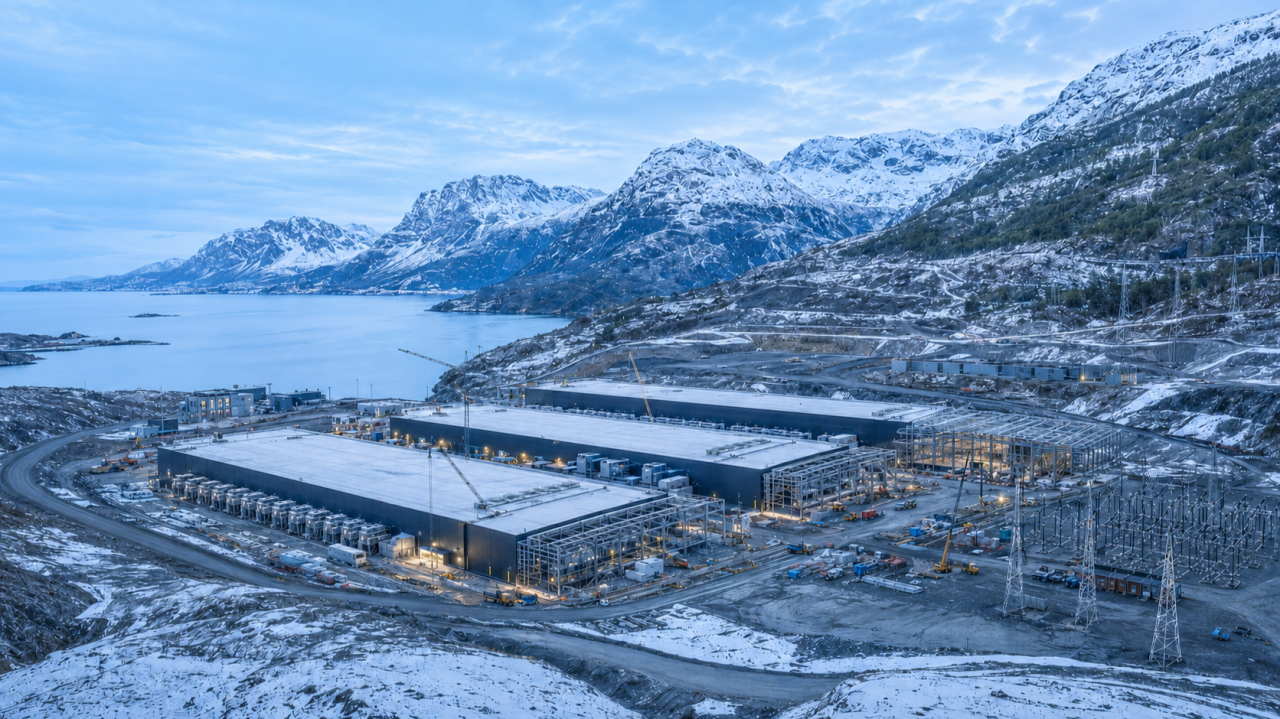
Stargate Norway is the cleanest European example. The Narvik facility is designed for 230MW of initial capacity with a further 290MW planned, powered entirely by renewable energy and using closed-loop liquid cooling. Its target is 100,000 NVIDIA GPUs by the end of 2026. In September 2025, the Aker-Nscale joint venture also signed a $6.2 billion agreement with Microsoft for staged delivery of AI compute from 2026.
Northern Norway is converting hydropower, cold weather and industrial land into contracted digital capacity. Geography supplies part of the margin; the offtake contract supplies bankability; jurisdiction supplies a strategic premium. Artificial intelligence may live in the cloud, but its returns begin at a substation.
Stargate UAE reaches the same conclusion through a different political economy. Its 1GW compute cluster will sit inside a 5GW campus in Abu Dhabi, with the first 200MW expected online in 2026. G42 will build it; OpenAI and Oracle will operate it; NVIDIA will supply Grace Blackwell systems; Cisco and SoftBank complete the alliance. The wider campus is expected to use nuclear, solar and natural gas. This is sovereignty through coalition: Emirati land, energy and capital paired with American technology and bilateral state alignment.
The sovereign megawatt is land, power, permission and political alignment compressed into one infrastructure asset.
These projects also explain why sovereign AI is moving beyond technology budgets. Norway is monetising an energy advantage. The UAE is turning state capital and diplomatic alignment into a regional compute hub. Both are building assets that resemble ports of intelligence: capital-intensive, location-sensitive, dependent on throughput and valuable partly because other economies need access to them.
The State Enters The Stack
The AI stack has developed a familiar habit: every supposed software problem eventually becomes an infrastructure budget. Governments once regulated data centres from the outside; they are now funding capacity, accelerating permits and creating domestic demand for the hardware inside them.
The European Union’s InvestAI initiative aims to mobilise €200 billion, including a €20 billion fund for up to 5 AI gigafactories. Its proposed Cloud and AI Development Act, adopted by the Commission on 3 June 2026, seeks to at least triple EU data-centre capacity within 5 to 7 years, streamline permitting and establish a common sovereignty framework for cloud and AI procurement.
The UK’s £1.1 billion AI Hardware Plan includes £750 million for a national heterogeneous AI supercomputer, with £400 million earmarked for next-generation chips and £150 million for advance purchases from innovative suppliers. Alongside it sit the £500 million Sovereign AI Fund, which is prioritising compute and AI hardware, and a separate £750 million procurement for the Next National Supercomputing Service in Edinburgh. Canada has committed C$2 billion over 5 years through its Sovereign AI Compute Strategy.
Infrastructure investors know the difference between a policy announcement and a cash flow. These programmes can shorten permitting paths, create anchor demand and widen financing options; they cannot rescue poor utilisation, weak counterparties or an obsolete hardware plan. The attractive opportunity sits where public ambition meets private discipline: contracted power, credible offtake and a refresh cycle for chips that age much faster than the building around them.
The Price Of Being Unable To Leave
Nation-states purchase optionality in sovereign megawatts. Companies often discover its value through what UK cloud provider Civo calls the “sovereignty tax”: outage exposure, compliance, egress charges, embedded workflows and the negotiating leverage lost when a provider becomes difficult to leave. It does not appear neatly on an invoice because it accumulates in the architecture.
Civo’s Digital Sovereignty Revolution 2026 surveyed 1,000 UK IT decision-makers and was cited by the House of Lords Library. The caveat is obvious and important: Civo is a sovereign-cloud vendor whose commercial proposition benefits from dissatisfaction with US hyperscalers. This is vendor-commissioned research rather than an independent audit.
Read with that caveat, the survey still maps a useful risk. Some 39% of respondents said they had experienced an outage originating from US hyperscaler infrastructure in the previous year; 29% of those affected reported a direct financial cost. Two-thirds said they would switch provider to regain sovereignty, yet only 15% had completed a migration to a domestic alternative and just 1 in 4 believed they could fully exit a major US provider.
The 51-percentage-point gap between the wish to switch and the act of switching is a map of the moat. Each year on a proprietary stack can add another data format, model endpoint, identity layer and egress cost. A House of Commons committee reached a similar conclusion about the public sector’s reliance on Palantir, Microsoft and AWS, describing Whitehall as “worryingly comfortable” with vendor lock-in. A switching cost, after all, is simply a moat recorded on the customer’s balance sheet.
For investors, portability therefore belongs in the discount rate. Uptime tells us whether the service worked yesterday. Exit optionality tells us whether the customer can keep operating tomorrow under another provider, model or jurisdiction. The latter is where sovereignty stops being a policy slogan and becomes an enterprise-value variable.
One Door Closes, Another Opens
Bloomberg reported on 17 July that the Trump administration was considering an independent, FINRA-style body to review frontier AI models with industry input. Treasury Secretary Scott Bessent helped develop the proposal; it would report to the Securities and Exchange Commission and was under review by White House Chief of Staff Susie Wiles. Its status is crucial: this is an internal proposal describing a voluntary pre-release review framework, not an enacted licensing regime. Its remit, structure and existence could all change.
The direction is still legible. After a period of ad hoc controls, including the Anthropic interruption, the US is considering a standing institution for model review. For frontier labs and their pre-IPO secondaries, that can mean slower release cadence, higher compliance costs and uncertainty around the products driving revenue. It may also mean fewer arbitrary surprises and a more credible safety framework. The investor’s task is to price the gatekeeper as both cost and potential stabiliser.
Then the other door moved. On 16 July, Beijing-based Moonshot introduced Kimi K3, a 2.8-trillion-parameter mixture-of-experts model with a 1-million-token context window. The model became available through Kimi’s products and API, with full weights scheduled for release by 27 July. Moonshot’s own evaluations place it below the strongest proprietary systems overall while reporting frontier-level results in several coding and knowledge-work tasks; early third-party tests cited by Reuters also showed strong performance.
The timing is exquisite. Washington is considering a gatekeeper for frontier models while China’s open-weight ecosystem is narrowing the performance gap. Middle powers unable to finance a frontier training run may still deploy a capable model on infrastructure they control. The rack can be sovereign, the weights can come from Beijing and the accelerators can come from California or Taiwan. Sovereignty, it turns out, is less a flag planted in a server room than a portfolio of dependencies.
Open-weight models do not make those dependencies disappear. Training data, complete methods and parts of the toolchain can remain closed; a 2.8-trillion-parameter system also demands serious infrastructure and security. They do, however, shorten the period during which any frontier lab can command a scarcity premium for capability alone. Model-access risk, regulatory review and open-weight substitution now belong in private AI valuations today, not in a distant tail-risk appendix.
Follow The Bottleneck, Price The Exit
The physical layer remains investable, with a narrower and more disciplined thesis. “AI infrastructure” is too broad to underwrite. The premium should attach to scarce grid access, contracted power, defensible cooling, fibre, permits and credible offtake. Capacity without utilisation is an expensive shed containing rapidly ageing hardware; state backing can improve bankability, though it cannot repeal depreciation.
At the corporate layer, exit optionality affects value on both sides of the contract. A customer able to move workloads has bargaining power and operational resilience. A customer unable to leave is an attractive recurring-revenue stream for the provider and a concentrated risk for everyone else. Portability, data egress, model substitution and jurisdictional redundancy deserve the same seriousness as uptime and service-level agreements.
At the model layer, pre-IPO investors need to underwrite more than technical capability and revenue growth. Release permissions, review regimes, access continuity and open-weight competition all influence the durability of a frontier lab’s valuation and its path to liquidity. The same question now runs through the entire stack: who holds the keys, how easily can the keys be changed and what happens to the asset when they are?
The data-centre thesis survives this analysis; it becomes more selective. The most durable assets will combine physical scarcity with contractual and jurisdictional flexibility, serve multiple models and providers, and offer customers a credible route out as well as a reliable route in. That is where a genuine sovereignty premium can accrue.
Food For Thought
The EU’s €20 billion gigafactory fund, Britain’s hardware programmes, Canada’s compute strategy and the sovereign megawatts rising in Norway and Abu Dhabi are purchases of optionality rather than exercises in technological autarky. Each creates a standing ability to choose another provider, model, route or jurisdiction when circumstances change.
Optionality is habitually underpriced while systems work and abruptly repriced when they fail. In AI infrastructure, the physical asset earns because it supplies compute. The strategic premium emerges because that compute can remain available, be redirected or run a different model when policy moves. That distinction will separate strategically resilient infrastructure from creatively financed capacity captive to a single tenant or technology stack.
Source Note
This edition draws on public statements from Anthropic dated 12 June 2026 and 30 June/1 July 2026; the House of Lords Library briefing “Digital and technology policy and national sovereignty”; Synergy Research Group cloud-market data; US Department of Justice CLOUD Act materials; Civo’s “Digital Sovereignty Revolution 2026”; official project announcements from OpenAI, Aker-Nscale and G42; European Commission materials on InvestAI and CADA; the UK AI Hardware Plan; Canada’s Sovereign AI Compute Strategy; Bloomberg’s 17 July reporting on the proposed US model-review body; Moonshot’s Kimi K3 technical announcement; and Reuters reporting on Kimi K3. Figures and policy status are current as at the date of publication.
DISCLAIMER Constellation is published by Nevv Capital for general information and discussion only. It is not investment, legal, tax or financial advice, nor a research report, and it is not an offer or solicitation to buy or sell any security, instrument or entitlement. References to companies, funds, technologies and projects do not constitute recommendations. Readers should conduct their own legal, regulatory, technical and investment due diligence.
© 2026 Nevv Capital. All rights reserved.