
Constellation · Nevv Capital
The Art Of The Engine
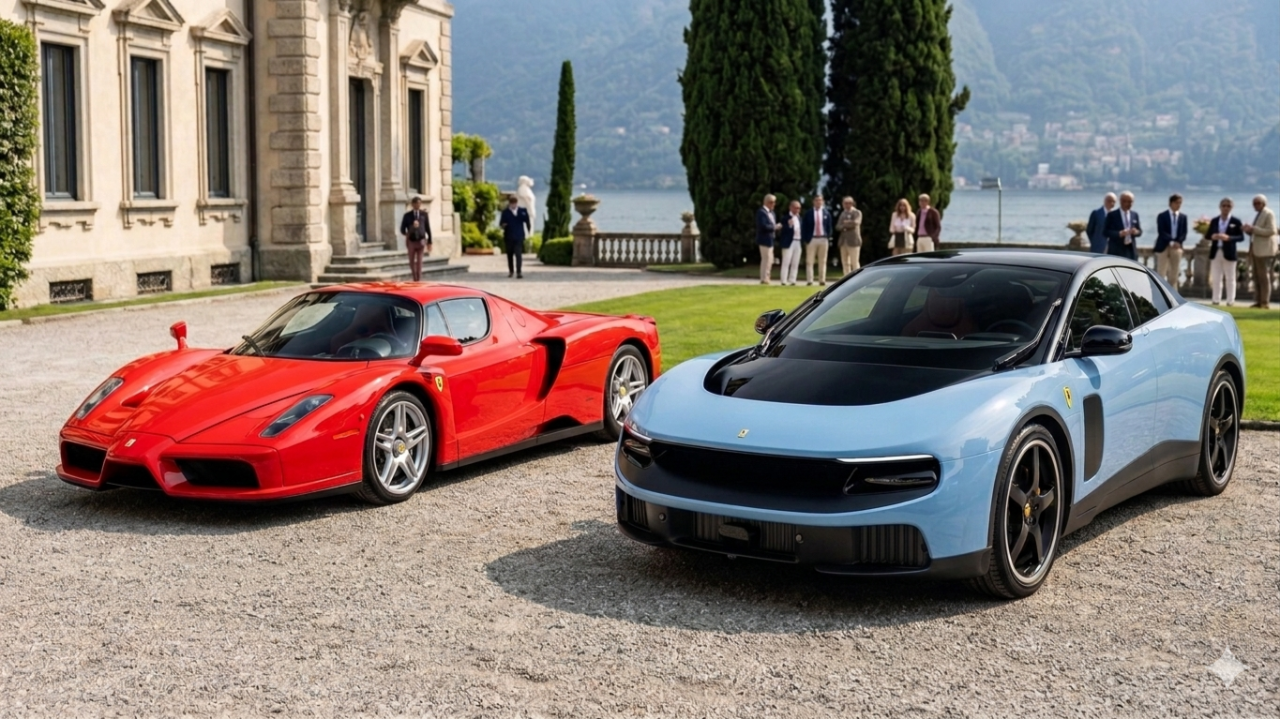
Ferrari unveiled its first electric car in Rome on Monday 25 May 2026. Its launch was such a big deal that Pope Leo and Italian President Sergio Mattarella were invited to view the luxury brand's first electric vehicle (EV). The unveiling of a Ferrari EV marks a major shift for a brand built on sleek petrol-powered supercars, known for their roaring engines.
Now, a 1000 horsepower is a 1000 horsepower. The car, called Luce, Italian for light, accelerates from 0 to 60 mph in under two and a half seconds, was developed with design input from Jony Ive’s LoveFrom, and will cost you approximately $640,000. By every measurable specification, it is an extraordinary machine.
But it is the way it looks that has drawn the most criticism.
Former Ferrari chairman Luca Cordero di Montezemolo told reporters on Tuesday that the Luce is "risking the destruction of a legend" and the firm should remove its iconic badge from the car.
By the close of trading the following day, the stock had fallen 8.4% in Milan and 5.3% in New York.
Anthony Dick, an automotive analyst at Oddo BHF, called it the furthest deviation from the brand's ethos the company has ever attempted, and described the market reaction as by far the sharpest he had ever seen to a car design. His conclusion was simple: the market had spoken. That is an interesting sentence to find on a research note, because it is not really about the car at all. It is about identity.
Enzo's Obsession
Enzo Ferrari founded Scuderia Ferrari in 1929 while still driving for Alfa Romeo. His interest was racing, entirely and without apology. Road cars came later, and only because racing requires funding, and funding requires customers, and customers need something to buy. The first car to carry the Ferrari name, the 125 S, appeared in 1947. Only two were built.
Enzo regarded his road-car customers as a necessary inconvenience standing between him and the next race. He did not particularly want to sell you a Ferrari. He wanted to win at Le Mans, and you were the means by which he financed that ambition. This is, when you think about it, an almost perfectly inverted version of how a normal business works.
The remarkable thing is that this contempt became the product. The waiting list, the allocation system, the sense that Ferrari decides whether you are permitted to buy rather than the other way around, all of it descends directly from a man who would genuinely have preferred not to deal with you. Scarcity at Ferrari was never a marketing strategy. It was a personality trait, monetised by accident and then protected by design. Customers understood the arrangement and loved it. They were not buying a car. They were buying proximity to an obsession that did not need them, and that indifference, paradoxically, was exactly what made it desirable.
When the Luce appeared, one of the first things Italy's own transport minister did was ask aloud what Enzo would have made of it. Nearly four decades after Enzo Ferrari’s death, the founder is still the unit of measurement against which every Ferrari is judged. That is not sentiment, it is the clearest possible evidence that the brand and the man have never, in the public mind, become separate things.
A Love Letter To The Journey
Ferrari keeps production unusually concentrated around Maranello and Modena, Italy, with bodywork and chassis shaped at the Scaglietti nearby Modena. Its cars are still made in a manner that is far closer to atelier logic than mass-production logic: engines, bodies, interiors, paintwork, testing and finishing remain part of a tightly controlled ecosystem built around craft, precision and scarcity.
Daily output runs to around ten to fourteen cars, in certain eras, against competitors who produce thousands before lunch. Each car takes roughly three weeks to complete from start to finish.
The work is overwhelmingly done by hand. Engines are cast in Ferrari's own foundry, where solid aluminium ingots are melted and poured into moulds by specialists, then assembled manually. The only fully automated step in engine assembly is the connection of the valve mechanics. Bodies are hand-fitted. Interiors are stitched and trimmed by master upholsterers. Robotics are used selectively, mostly on the paintwork, where they genuinely add precision, but the centre of gravity of the entire operation sits with the human hand. This is not a factory; it is an atelier with a test track.
Then there is the question of how you acquire one. With the most desirable Ferraris, the honest answer is that you do not acquire one, you are invited. The Icona series, Ferrari's most exclusive programme, launched in 2018 with the Monza SP1 and SP2. The Daytona SP3 followed in 2021: 599 units, approximately $2.25 million each, every single car allocated to existing top clients before the public unveiling. The unveiling itself was a courtesy extended to everyone else. The business was already done. To be considered for an Icona allocation, you need a meaningful history of Ferrari ownership and a relationship the company values. Money alone is not sufficient. This is not a sales process. It is a curatorial decision, and Ferrari is the curator.
Ferrari also operates Ferrari Classiche, an in-house workshop founded in 2006 that restores and certifies older cars, treating its back catalogue rather as a museum treats its permanent collection. So to summarise: Ferrari builds its cars by hand, allocates the most desirable ones by invitation, and then restores them decades later in its own dedicated workshop. The object that results is, by any reasonable definition, closer to a sculpture than a vehicle. A Ferrari is a love letter to the idea that something made by human hands, with obsession and patience, is worth more than anything a machine can produce at scale.
The Most Beautiful Noise Ever Made
The shape stops people in the street. Not glances; stops. People turn around. Conversations pause. A Ferrari in motion is a piece of moving sculpture in a world of ordinary metal, and the human eye responds to it the way it responds to great art, with an involuntary arrest of attention that happens before the conscious mind has caught up.
Then there is the engine. The V12 note does not arrive through the ears first. It arrives in the chest, a low resonance you feel as vibration before you register it as sound. When the throttle opens, the acceleration presses you physically into the seat, and the body produces adrenaline in response, the same flush of fight-or-flight that the nervous system reserves for genuinely significant events. The involuntary intake of breath. The smile nobody can suppress. The smell of warm oil and brake dust that hangs around the car after it stops. The heat distorting the air above the engine bay for a full minute afterward.
A 250 GTO changes hands today for tens of millions of dollars. People paid for beauty, for the particular romance of owning something that seemed almost alive in their hands. They paid to feel something the rest of their life rarely produced. The engineering was only the delivery mechanism for a sensation, and the sensation was the asset.
An electric motor cannot deliver that sensation, and cannot be made to. It is immediate, smooth, quiet and reproducible. The thousand horsepower in the Luce is real and genuinely impressive, but it is the kind of brilliance that scales, licenses and gets matched. A Tesla already out-accelerates most Ferraris ever built, for a fifth of the price. Raw speed stopped being scarce years ago. What Ferrari actually sells, the drama, the beauty, the adrenaline, the noise that lives in your chest, does not scale. That was always the point.
Ferrari understands this, which is why the Luce does not run in silence. The company has engineered a system that amplifies the genuine vibrations of the electric drivetrain, an honest attempt to give the car a voice without faking an engine it does not have. It is a thoughtful piece of work. It is also a significant admission. A company does not go to that trouble unless it knows, with some certainty, that the noise was a material part of what it was selling.
The Luce is therefore not really a product launch. It is a public experiment, conducted with shareholders' capital, to determine whether the passion, the beauty and the adrenaline can survive the engine that produced them. Whether those things live in the object, or only in the story we have told about it. The market, very sensibly declining to pre-pay for the answer, marked its uncertainty down 8.4%.
Buy The Thing, Not The Story
None of this is an argument for nostalgia. The electric era is coming and the engineering behind it is serious. The combustion engine will end up in a museum, which is the correct and dignified fate for beautiful obsolete machinery. The V12 is among the finest sounds industrial civilisation has ever produced, and it is worth saying so clearly while it is still here to be heard.
Enzo's lesson was that value is a by-product of obsession with the thing itself. He chased the win, completely and without apology, and the scarcity, the myth and eventually the legacy arrived as consequences. He did not construct a story and then hope a car showed up to justify it. Own the thing, not the story about the thing. Build the thing, not the story about the thing.
Food For Thought
Enzo Ferrari built a legend through the power of obsession. Everything else, the scarcity, the desire, the decades of waiting lists, arrived as a consequence he barely paused to acknowledge. That is the part of the story that gets lost in the romance. The value was never merely engineered. It was the natural residue of an obsession so complete that the product could not help but carry it. The customers felt it because it was real. They felt it in the noise, the heat, the violence of a machine made by people who cared about exactly one thing.
The Luce will find its buyers, and some of them will love it genuinely and without reservation. The more useful exercise is to look honestly at what you own and what you are building, and ask the question now:
Whether the passion survives the engine that produced it. Whether seven decades of accumulated substance can carry a badge across a silence it was never designed to cross. The market's verdict, down 8.4% in a single session, was not a judgement on the engineering; it was a question about the soul.
The rest of us face quieter versions of the same reckoning, with less ceremony and no share price to mark it. In a fund, a company, a body of work, the question is always the same.
Is what you are building real enough to outlast the story you are telling about it? Does the thing itself carry the weight, or have you been relying, more than you realised, on the story around it?
Enzo never had to ask, the obsession made the answer obvious.
That is still, for most of us, the hardest thing to build.
Constellation is the investor editorial series of Nevv Capital. At Nevv, we curate legacies. Our strategy is to provide sophisticated investors the tools, insights, and access to participate intelligently in the alternative assets universe.*
DM or WhatsApp us to learn more.*
*For professional and accredited investors only.
Disclaimer: This edition of Constellation is shared for general information and educational purposes only. It does not constitute investment advice or a personal recommendation, nor should it be treated as an offer to sell, a solicitation to buy, or an invitation to engage in any transaction involving securities, funds, alternative assets, or any other financial instruments.
Past performance is not a reliable indicator of future results. The value of investments can fall as well as rise, and readers may not recover the amount originally invested. Before taking action, readers should seek independent financial, legal, tax, or other professional advice appropriate to their individual circumstances.
This publication does not include paid promotions, partnerships, or sponsored endorsements of any kind.