
Constellation · Nevv Capital
The Greatest Wealth Transfer In History Needs Plumbing Nobody Has Built

Adam Smith argued that private capital, freely deployed by individuals, creates more wealth than any authority can direct. Two and a half centuries later, the regulatory architecture to make that true is finally being built. The question is whether the infrastructure to make it work will arrive in time, and who will build it.
In 1776, one of the most original minds of the Scottish Enlightenment, Adam Smith, philosopher, economist, and the man whose thinking would lay the intellectual foundations of modern capitalism, published a book that would quietly dismantle the economic orthodoxy of his age. An Inquiry into the Nature and Causes of the Wealth of Nations, the product of a decade of thinking, argued that nations grow wealthy not through the directed accumulation of gold or the managed control of trade, but through productive labour, exchange, capital accumulation and free deployment of private capital by individuals pursuing their own interests within a framework of law and institutions. In doing so, Smith proposed, each person is led by what he called an invisible hand to promote ends that were no part of their original intention, chief among them the prosperity of society itself. It was a direct challenge to mercantilism, the governing doctrine of the day, which held that wealth required management from above. Smith said it required only freedom from below.
History, over the following two and a half centuries, largely vindicated him. Economies organised around private capital and free markets generated wealth at a compounding rate that centrally directed systems could not match. The division of labour, the accumulation of capital, the natural price mechanism; each of Smith's core ideas found its confirmation in the industrial transformation of the nineteenth century and the financial architecture of the twentieth. He is remembered, rightly, as the father of modern economics.
A Brief History of Exclusion
Smith's theoretical framework took roughly 125 years to produce its first recognisable form of organised private capital. In 1901, J.P. Morgan purchased Carnegie Steel from Andrew Carnegie and Henry Phipps for $480 million, the largest private transaction in history to that point. Phipps invested his share through what became the Bessemer Trust, an early family office deploying private capital across exclusive holdings. It was private markets in embryonic form: high returns, long horizons, and access limited to the very wealthy.
The modern industry emerged from the wreckage of the Second World War. In 1946, Georges Doriot, a French-born Harvard professor and the man now called the 'Father of Venture Capitalism', founded the American Research and Development Corporation, the first institutional private equity firm, to channel capital into businesses run by returning soldiers. ARDC's 1957 investment of $70,000 in Digital Equipment Corporation was later valued at over $355 million after DEC's 1968 IPO, a 500-times return that announced to the world what patient private capital could do. But it remained an industry for the few. The regulatory architecture of post-war America, ERISA restrictions, capital gains taxes, accredited investor rules, ensured that institutional investors and high-net-worth individuals held a structural monopoly on access to private markets for decades.
The buyout era of the 1980s, KKR and Blackstone and Carlyle, the $31.1 billion RJR Nabisco deal that defined an era, was built on the same structural exclusivity. Private equity was private in the most literal sense: closed to ordinary investors by law, by minimum investment size, by liquidity requirements, by the sheer operational complexity of participation. The asset class compounded quietly for those inside the wall, while the vast majority of investors held stocks and bonds and wondered why their returns looked modest by comparison.
Seventy years after Doriot founded ARDC, private markets manage nearly $15 trillion in assets. Alternative assets are compounding at 12.3% annually, twice the rate of public market AUM. The industry is on a trajectory to $30 trillion by 2030. And yet the share of retail and mass-affluent investors in those assets remains negligible.
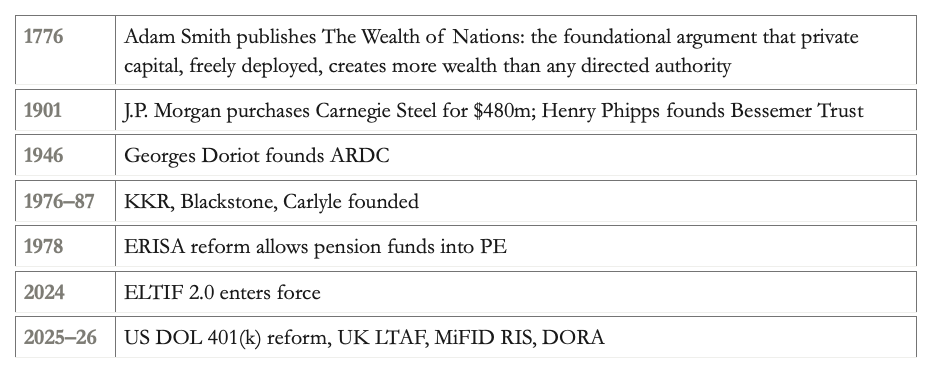
That is now beginning to change, as demand shifts and regulators move in the same direction. Across Europe, the UK and the US, the rules are shifting in the same direction. ELTIF 2.0 has made retail access to private markets more workable in Europe; broader EU reforms are widening the potential client base further. In the UK, the FCA’s proposed targeted-support regime points to a future of more scalable, technology-enabled guidance. In the US, the push to bring alternative assets into 401(k) plans signals a similar shift in regularity attitude. At the same time, DORA has raised the operational bar for financial firms across Europe, while new data-sharing reforms are beginning to lay the foundations for a more connected financial system. The legal architecture for broader access is starting to emerge.
Inheriting a Fortune Whilst Navigating a Storm
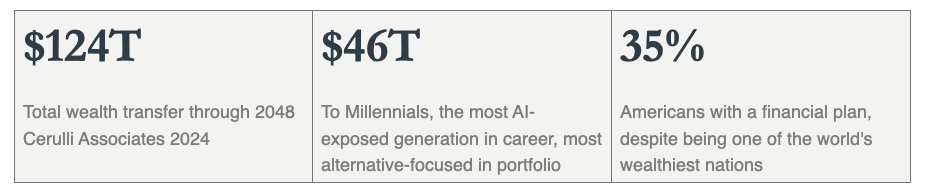
Into that opening comes the largest intergenerational transfer of wealth in recorded history. Cerulli Associates' most recent research projects $124 trillion changing hands through 2048, with $105 trillion flowing to heirs and nearly $19 trillion to charity. $100 trillion will be transferred from Baby Boomers and older generations, representing 81% of all transfers.
More than half, $62 trillion, will come from HNW and UHNW households that together represent just 2% of all US households. Before any of it reaches the next generation, $54 trillion passes horizontally between spouses, with nearly $40 trillion going to widowed women who will, in many cases, be managing meaningful assets on their own for the first time.
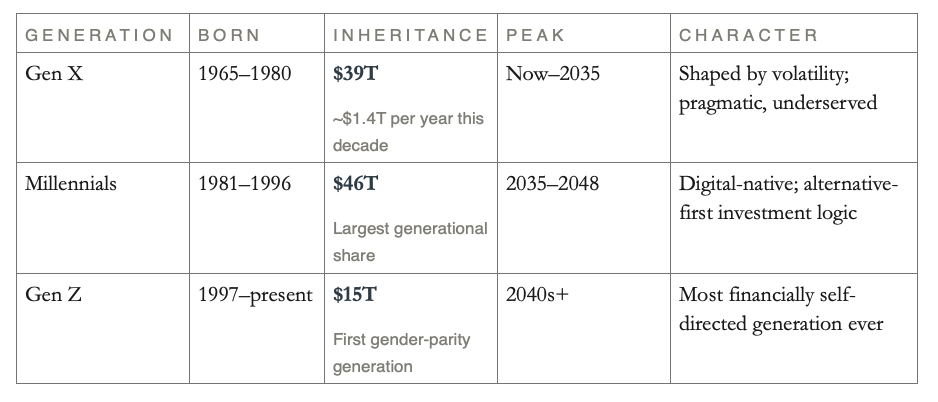
The generational sequencing is unsparing: Gen X inherits $39 trillion over the next decade at roughly $1.4 trillion per year; Millennials inherit $46 trillion, the largest single-generational share, with their peak transfer decade running from 2035 to 2048; Gen Z inherits $15 trillion as the first generation to achieve gender inheritance parity.
The transfer arrives with a complication that is not being discussed in private markets with sufficient seriousness. The generation inheriting this capital is itself being disrupted by the same technological force that is remaking wealth management. AI was cited in over 91,000 announced job cuts since 2023, accelerating sharply into 2026. Entry-level software engineers aged 22 to 25 saw roughly a 20% decline in employment from their 2022 peak. The unemployment rate among recent college graduates reached 5.7% in Q4 2025. Citigroup estimates 54% of financial sector jobs carry high automation potential. BlackRock CEO Larry Fink warned in his shareholder letter of the 'real risk' that AI widens wealth inequality, with enormous rewards for those on the inside and structural disruption for those who are not.
That might have been manageable if they were inheriting into a more stable economic and professional environment. A generation that might previously have expected a steady rise in income, a conventional career arc and a gradual introduction to wealth management may now face something more uneven: career volatility, periods of dislocation, and earlier responsibility for more complex financial decisions. Only 35% of Americans have a financial plan. In a 2023 European Commission survey, 82% of respondents rated themselves as having medium or low financial literacy despite 71% claiming to set financial goals.
That changes the context of inheritance. Receiving capital in your thirties or forties is one thing. Receiving it while the structure of professional life is shifting under your feet is another, and that is before one gets to financial literacy.
The industry likes to assume that heirs will simply be absorbed into existing advisory channels; some will and many will not. A meaningful share will want more control, faster answers, better tools and lower friction. They will not have much patience for paper-heavy processes, opaque reporting or a relationship model designed around quarterly calls and inherited trust. They will expect finance to work more like the rest of their digital lives.
The Heirs Have a New Investment Philosophy
According to Bank of America Private Bank's 2024 Study of Wealthy Americans, 72% of investors aged 21–43 believe it is no longer possible to achieve above-average returns through traditional stocks and bonds alone. Among those over 44, only 28% agree. Alternatives and crypto already comprise 31% of younger investors' portfolios, compared to 6% for older investors.
According to another study conducted by Boston Consulting, The Millennial Mindset: How the US’s Largest Generation Earns, Invests, and Spends, 69% millennials prefer to manage their investments themselves without the help of a wealth manager, compared with 53% of Gen X and 36% of baby boomers. Wealthy millennials invest more diversely across asset classes, with private equity (63%) and cryptocurrency (62%) topping the list of alternative assets.
Some 82% of investors aged 24–43 consider ESG track record when making investment decisions, a factor that barely registers for the transferring generation.
A portfolio of domestic equities and investment-grade bonds, the foundational product of the wealth management industry for sixty years, ranks 14th in order of priority among younger wealthy investors. The platforms they are inheriting into were built for their parents.
Much of wealth management still runs on an architecture designed for another era: segmented accounts, disconnected data, manual onboarding, limited portability, compliance systems bolted on after the fact, and service models built around the economics of older client relationships. It is a system that can function reasonably well when product ranges are narrow and distribution is slow. It is much less convincing when private assets, AI tools and multi-entity financial lives begin to collide.
AI and the New Economics of Wealth Management
In February 2026, fintech group Altruist introduced an AI platform designed to generate sophisticated tax-planning strategies across large numbers of client accounts. Investors reacted sharply, marking down Charles Schwab, LPL Financial and Raymond James in a single session. EY’s 2025 research found that 68 per cent of wealth management firms expect substantial workforce transformation over the next five years, particularly in middle- and back-office functions. The immediate implication is not that advisers disappear. It is that AI is beginning to put pressure on the cost base and operating model that have long underpinned wealth management at scale.
On the consumer side, the shift is moving quickly. In April 2026, Perplexity connected its AI agent to users’ bank accounts, credit cards, loans and investment portfolios through Plaid’s network of more than 12,000 financial institutions, giving subscribers a consolidated, real-time view of their finances and the ability to query that information in plain language. Revolut is rolling out account actions through chat. Public has introduced AI agents that can monitor markets and execute trades based on user-defined instructions. None of these companies is a traditional high-street bank or wealth manager in the old sense. Yet collectively they are moving towards something the industry has long promised, but rarely delivered: a more unified, more intelligent and more continuous interface for managing personal finances. More than 75 per cent of Perplexity’s users already ask it finance questions each month. Demand, in other words, is not the missing piece.
The central question is no longer whether AI will enter wealth management. It is which firms will build the infrastructure, controls and client experience to make that shift workable at scale.
Food for Thought
The next decade in wealth management will not be won only by those who gather the most assets or design the sleekest user experience.
It will be won by those who build the systems that everything else eventually has to run on.
Structural gaps of this kind rarely get filled by incumbents quickly. Legacy wealth platforms, many still shaped by fragmented systems and overnight batch-processing logic, are not designed to rebuild for this moment at speed. More often, they will have to buy, partner, or adapt around the firms that were built correctly from first principles.
The infrastructure builders of this cycle may not attract the same attention as consumer-facing platforms in the early years. But over time, financial services will come to depend on them with increasing clarity. They will provide the rails beneath broader access, the controls beneath intelligent advice, and the operating architecture beneath a more complex investor world.
That is why they matter.
The visible story may be democratisation, but the investable story is infrastructure.
Constellation is the investor editorial series of Nevv Capital. At Nevv, we curate legacies. Our strategy is to provide sophisticated investors the tools, insights, and access to participate intelligently in the alternative assets universe.*
DM or WhatsApp us to learn more.*
*For professional and accredited investors only.
Disclaimer: This edition of Constellation is shared for general information and educational purposes only. It does not constitute investment advice or a personal recommendation, nor should it be treated as an offer to sell, a solicitation to buy, or an invitation to engage in any transaction involving securities, funds, alternative assets, or any other financial instruments.
Past performance is not a reliable indicator of future results. The value of investments can fall as well as rise, and readers may not recover the amount originally invested. Before taking action, readers should seek independent financial, legal, tax, or other professional advice appropriate to their individual circumstances.
This publication does not include paid promotions, partnerships, or sponsored endorsements of any kind.
Sources: Adam Smith, An Inquiry into the Nature and Causes of the Wealth of Nations (1776) · Cerulli Associates 'U.S. High-Net-Worth and Ultra-High-Net-Worth Markets 2024' · Bank of America Private Bank '2024 Study of Wealthy Americans' · Boston Consulting Group / Worth Media Millennial Wealth Survey 2024 · Morgan Stanley Sustainable Signals 2024 · McKinsey 'US Wealth Management in 2035' (January 2026) · Morningstar ELTIF analysis (March 2026) · UBP Private Markets Outlook 2026 · EY GenAI in Wealth and Asset Management Survey 2025 · Shulman Rogers DOL legal alert (March 2026) · FCA CP25/36 (December 2025) · Challenger Gray & Christmas AI displacement data 2026 · Dallas Federal Reserve AI employment research · BlackRock Larry Fink shareholder letter 2026 · JPMorgan AI jobs disruption analysis (February 2026) · IPEM Wealth 2026