
Constellation · Nevv Capital
The House Always Waives
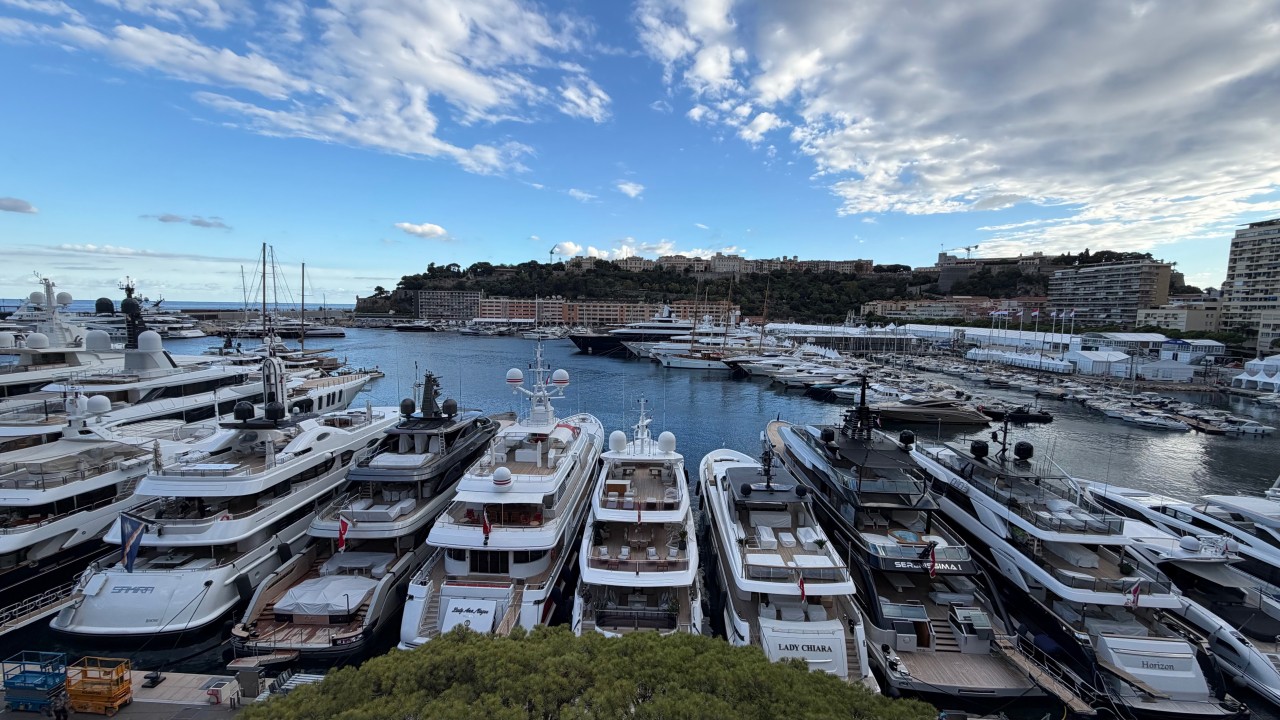
How Monaco turned scarcity, sovereignty and two square kilometres of Mediterranean coast into an operating system for wealth.
Monaco is the world’s second-smallest country, ruled by the Grimaldi dynasty, whose history on the Rock stretches back more than seven centuries.
Approach Monaco along the coast and the space begins to close in before the wealth becomes visible. The Mediterranean fills one side of the view, while the mountains rise sharply on the other, leaving a narrow strip between them. Then the principality appears, not so much spread across the landscape as fitted into it: apartment buildings climbing the hillside, roads disappearing into the rock and emerging several levels higher, terraces suspended above streets and towers rising behind the older façades of Monte-Carlo.
Once inside, the compression becomes even more striking. Public lifts perform the work that ordinary streets would do elsewhere, carrying people vertically between districts. Below, Port Hercules is crowded with yachts; above it sit the Hôtel de Paris, the Casino de Monte-Carlo and the Belle Époque architecture through which Monaco has presented itself to the world for more than a century. Along parts of the shoreline, the geography itself has changed. Where the country ran out of land, it eventually created more.
I was there recently for an investor gathering, and what stayed with me this time was less the familiar display of wealth than how the place itself has been physically organised around it. Monaco does not simply contain capital; over generations, it has reshaped itself to accommodate, attract and retain it.
Seen this way, the yachts, private banks, hotels, apartment towers and reclaimed coastline are not separate curiosities. They are different layers of the same economic history.
That history began long before Monte-Carlo, and long before Monaco became synonymous with wealth.
The Rock And The Bet
The Grimaldi connection with Monaco dates to 1297, when François Grimaldi seized the fortress on the Rock. Charles I became the first Grimaldi Lord of Monaco in 1331; Honoré II adopted the title of Prince in 1614; and despite periods of foreign protection and even French annexation during the Revolution, the dynasty repeatedly returned to the Rock.
By the nineteenth century, Monaco’s political identity was already the product of centuries of dynastic survival.
That history makes what happened next all the more significant.
Menton and Roquebrune were established towns within the wider Grimaldi domain. Menton, the larger of the two, was an agricultural and trading community on the coast, while Roquebrune occupied a strategically important position between Monaco and Menton. Together they represented 80% of Monaco's total territory, a substantial share of its population and much of its agricultural wealth.
When both towns broke away from Monegasque rule in 1848, the consequences were therefore far greater than a simple change of border. Tensions had been building under Prince Florestan I, driven in part by resentment over taxation and demands for greater political autonomy, and the revolutionary wave sweeping Europe that year provided the catalyst. Menton and Roquebrune declared themselves free cities and placed themselves under the protection of the Kingdom of Sardinia, severing Monaco from much of the territory, population and productive land on which it had long depended.
The dispute remained unresolved for more than a decade. In 1861, as the political map of the region was being redrawn, Prince Charles III formally renounced Monaco’s rights over Menton and Roquebrune in return for four million francs. France recognised the sovereignty of the remaining principality, while the settlement also laid the groundwork for closer road and railway connections along the Riviera.
The dispute remained unresolved for more than a decade. In 1861, Monaco and France signed the Franco-Monegasque Treaty, under which Prince Charles III formally renounced Monaco’s rights over Menton and Roquebrune in return for four million francs. France recognised the sovereignty of the remaining principality, while the treaty also established a new framework for relations between the two states, including customs arrangements and improved road and railway connections along the Riviera.
The territorial loss was enormous. Monaco was left with a narrow coastal state and very little conventional economic scale. Much of the productive land and population associated with Menton and Roquebrune had gone, leaving the principality in serious financial difficulty.
For a dynasty whose history had been defined by holding on to territory, the paradox was striking: the Grimaldis had preserved Monaco, but the Monaco they now controlled was dramatically smaller and economically fragile. Agriculture could no longer provide a meaningful answer, while industrialisation offered few obvious advantages to a state with so little land and such a small domestic market.
What Monaco retained, however, was something less visible and ultimately more valuable: the right to determine its own rules.
Under severe financial pressure, Prince Charles III, who succeeded his father Florestan I in 1856, needed a radically different source of revenue. That urgency pushed Monaco towards gaming, which it could permit within its own borders at a time when gambling was restricted across much of Europe.
The decisive shift came with François Blanc and the creation of the Société des Bains de Mer in 1863, which transformed the Monte-Carlo Casino into the foundation of a new economic model for the principality. Blanc’s achievement was not merely to operate a casino. He understood that legality alone would never turn a small Mediterranean principality into a destination for Europe’s wealthy. The entire experience had to become desirable.
Around the casino came the Hôtel de Paris, restaurants, gardens and entertainment. The Café de Paris followed in 1868. Charles Garnier, already celebrated for the Paris Opéra, later designed the Salle Garnier in Monte-Carlo.
What began as an advantage created by regulation gradually became something far richer: an environment. The casino provided the initial reason to travel. Monte-Carlo supplied the reason to remain. That distinction would define everything that followed.
The Waiver
Then came the elegant part.
The casino and the economy developing around it became successful enough to alter Monaco’s relationship with taxation itself. In 1869, Charles III abolished a range of direct taxes, including personal, land and property taxes. More than a century and a half later, that decision remains one of the defining features of the principality: most residents still pay no personal income tax in Monaco, while French nationals remain the principal exception under later Franco-Monegasque arrangements.
It is easy to look back at this as the beginning of a grand philosophy of low taxation. In reality, it was far more pragmatic. Monaco had created a sufficiently productive alternative source of revenue that it could afford to waive much of the direct taxation imposed on the people who lived there.
That waiver changed the proposition.
Monte-Carlo had originally been designed to attract visitors who would arrive, spend and eventually leave. Once direct personal taxation disappeared, wealthy visitors acquired another reason to consider Monaco not simply as a destination but as a place of residence.
What began as fiscal pragmatism gradually became one of the most powerful pieces of positioning in the history of the principality.
The state monetised activity elsewhere in the system and waived the charge on the resident. Over time, the waiver itself became part of the product.
That distinction matters because once a concession becomes embedded in the identity of a place, withdrawing it becomes vastly more difficult. For Monaco, the absence of personal income tax evolved from an economic consequence into an expectation, and then into a brand.
The effect was self-reinforcing. Wealthy residents required bankers, lawyers, property advisers and increasingly sophisticated financial services. They needed schools, restaurants, construction, security, healthcare, luxury retail and hospitality. Each new layer of infrastructure made Monaco more attractive to the next generation of residents, whose arrival supported an even deeper service economy.
The tax advantage opened the door. The ecosystem persuaded people to stay.
This is why Monaco is poorly explained by tax alone. There have been many jurisdictions with favourable tax regimes, yet very few have developed Monaco’s particular combination of scarcity, security, financial services, Mediterranean lifestyle, political continuity and accumulated social prestige.
Eventually, the concentration of wealth became an advantage in itself. Monaco became more useful to wealthy residents precisely because other wealthy residents, advisers and institutions were already there.
The waiver had created something much larger than a tax advantage.
Building The Myth
If Charles III and François Blanc constructed the economic foundation, Rainier III understood that an enduring wealth destination required something beyond favourable economics. It needed identity.
The Monaco Grand Prix had first been staged in 1929, but television transformed its significance. The race gave Monaco something few destination-marketing campaigns could ever purchase: recurring global images of the harbour, the terraces, the casino and the extraordinary topography of Monte-Carlo, broadcast as part of the spectacle itself.
The Formula One cars were the ostensible subject, but Monaco was always in the frame.
Rainier’s marriage to the American actress, Grace Kelly, in 1956 changed Monaco’s place in the post-war imagination. The principality already had wealth and notoriety; Princess Grace brought Hollywood, romance and a modern form of royalty. Monaco became not merely somewhere affluent people visited, but a place onto which ideas of glamour and aspiration could be projected.
This mattered because the movement of wealth has never been purely financial. People choose where to build their lives through a mixture of economics, security, identity, relationships and desire.
Rainier also understood that welcoming private capital did not require surrendering strategic control to it.
During the 1950s, Aristotle Onassis had accumulated a powerful position in Société des Bains de Mer, giving him considerable influence over the company that controlled the casino, major hotels and strategically important property interests. As his vision for Monaco diverged from Rainier’s, the state intervened.
In June 1966, Monaco passed Law No. 807, creating 600,000 new SBM shares and allocating them to the state. The capital increase materially strengthened government influence over the company and diluted existing shareholders, including Onassis.
The significance of the episode lies less in the corporate mechanics than in what they reveal about Monaco itself. SBM was never simply another listed company. It was part hospitality group, part property owner and part strategic infrastructure for the principality.
Monaco wanted international capital, but it also wanted control over the institutions that made Monaco valuable.
How Wealth Shapes A Place
Capital has also changed Monaco culturally.
François Blanc’s Monte-Carlo was not simply a place in which wealthy visitors consumed luxury; it became a serious producer of culture. The Salle Garnier established Monaco on the European operatic circuit, while the Ballets Russes later made Monte-Carlo an important artistic centre. Wealthy audiences and patrons financed cultural production, and the culture they supported made Monaco more desirable in return.
That relationship was part of the original model. The casino produced revenue, but architecture, music, hospitality and spectacle gave Monte-Carlo distinction.
Modern Monaco still supports important cultural institutions, including the Opéra de Monte-Carlo, Les Ballets de Monte-Carlo, the Philharmonic Orchestra and the Grimaldi Forum. Nineteenth-century Monte-Carlo had to manufacture desirability. Today’s Monaco inherits more than a century and a half of it.
Once the address itself becomes exceptionally valuable, the city begins to respond differently. Buildings are no longer judged solely as architecture but also as financial assets. Retail and hospitality adapt to the spending patterns of an international population. Land that once supported villas becomes valuable enough to justify vertical development, while infrastructure increasingly serves a population whose financial and personal lives extend across multiple jurisdictions.
Monaco is an unusually compressed example of a question that many global cities now confront: what happens to a place when its desirability becomes a financial asset in its own right?
There is no simple answer. Wealth finances institutions, investment and cultural life while at the same time altering the cost, physical form and social composition of the place in which it accumulates. Monaco simply allows us to observe those forces within a very small frame.
The Monaco Model Travels
This is where Monaco’s story becomes more than a historical curiosity.
Around the world, jurisdictions are competing more actively for internationally mobile entrepreneurs, investors, family offices and wealthy households. What they are building is not necessarily Monaco replicated elsewhere; rather, different cities and states are assembling different components of the same broader proposition.
Dubai and Abu Dhabi combine low personal taxation with infrastructure, connectivity, property and increasingly sophisticated private-capital ecosystems. Singapore relies more heavily on institutional credibility, regional access and financial depth. Switzerland’s position has been built over generations around political stability, banking expertise and legal certainty, even as the meaning of financial privacy has changed dramatically. Italy has used fiscal incentives to attract internationally mobile residents, while Miami combines favourable domestic taxation with lifestyle, connectivity and access to American and Latin American capital.
These places should not be thought of as different stages of a single Monaco playbook. Their histories, economies and political structures are far too different for that. What they share is a recognition that the location of capital increasingly follows the location of the people who own and allocate it.
For much of economic history, governments competed primarily for companies, factories, headquarters and jobs. Those competitions continue, but a parallel contest is increasingly taking place for founders, investors and family wealth. When those individuals move, they rarely move alone. Property purchases follow. Advisers follow. Businesses may follow. Philanthropy, investment activity, education spending and professional networks can follow too. Over time, the resulting ecosystem can become self-reinforcing, just as it did in Monaco.
The difficulty is that tax incentives can be copied relatively quickly. Networks, reputation and institutional trust cannot. That may be Monaco’s deepest competitive advantage.
The tax proposition is famous, but the real moat is the accumulation of more than 160 years of association between the principality and private wealth.
Food for Thought
Monaco’s story began with constraint.
A principality that had lost most of its territory needed a new economic model, and sovereignty gave it room to construct one. Gaming initially provided the revenue engine. Hospitality transformed that engine into a destination. Then came the decision that would shape everything afterwards: Monaco waived the direct personal tax burden that might otherwise have accompanied residency and allowed the waiver itself to become part of the proposition.
Wealthy residents created demand for increasingly sophisticated services, while culture, spectacle and architecture supplied the identity that made Monaco more than an efficient fiscal arrangement.
Over time, each element strengthened the next.
Then the limits of success became apparent. France demonstrated that a waiver granted by one jurisdiction can still be challenged by another. Onassis showed why strategic economic assets mattered to the state itself. Land scarcity forced Monaco to build vertically and eventually into the sea. A labour market much larger than the resident population extended the principality’s economic footprint into France and Italy. International financial regulation has required the old culture of discretion to evolve towards a much more transparent model.
Monaco reinvented itself through these challenges and refined its proposition.
That may be the most important lesson in the story. Wealth does not move simply towards the lowest tax rate, because taxation is only one component of a much larger decision. Capital moves with people, and people choose environments in which they believe their capital, families, relationships and lifestyles can function over time.
They value security and legal certainty. They value connectivity, infrastructure and competent professional services. They value education, culture and quality of life. They value networks and, perhaps more than any brochure will admit, the presence of other people like themselves. Monaco assembled those elements gradually, long before anyone described such a system as an ecosystem for private wealth.
More than 160 years later, other jurisdictions are attempting to create their own versions of it. Some have vastly more land, larger economies or newer infrastructure. Some sit closer to the growth markets of the future. Some can offer incentives that Monaco cannot. What is harder to reproduce is time.
Monaco’s reputation has been compounding for generations. Its fiscal regime, institutions, cultural mythology, property scarcity and social network have become intertwined to the point that separating one from the others misses how the system actually works.
The casino was the original economic engine, but the enduring achievement was not the casino. It was the place that grew around it. And the waiver was what helped turn that place from a destination into a home for capital.
The house always wins. In Monaco’s case, the house learnt when not to charge.
DISCLAIMER Constellation is published by Nevv Capital for general information and discussion only. It is not investment, legal, tax or financial advice, nor a research report, and it is not an offer or solicitation to buy or sell any security, instrument or entitlement. References to companies, funds, technologies and projects do not constitute recommendations. Readers should conduct their own legal, regulatory, technical and investment due diligence.
© 2026 Nevv Capital. All rights reserved.