
Constellation · Nevv Capital
The Return of Wonder
On Beauty, Resilience, and The Defiant Human Habit of Making Light in The Dark
Something strange happens when the world breaks.
Not immediately. First comes the silence, the grief, the particular numbness of people who have lived through too much and have not yet found the language for it. The cities stand damaged or diminished. The institutions that were supposed to hold things together have revealed their fragility. The future, which once felt like a destination, now feels like an open question with no familiar answers.
And then, quietly at first and then with gathering force, something else begins.
Music finds its way into the streets. Colour returns to the walls. Writers reach for words that did not exist before because the experiences they are trying to describe did not exist before. Designers reimagine what a building, a dress, a chair, a city could be. Artists make work that is not about what happened but about what it means to still be here, still breathing, still capable of desire and fury and wonder.
History has a word for this. Several words, actually, depending on the century and the geography. Renaissance. The Jazz Age. The Roaring Twenties. The Swinging Sixties. Each name points to the same phenomenon: the extraordinary, recurring, almost defiant human habit of answering devastation with beauty.
It is not a market signal. It carries no yield. It appears in no risk model and no geopolitical forecast. And yet it may be the single most reliable indicator of human recovery ever observed.
The Arithmetic of Grief
Consider the arithmetic of 1918.
The First World War had killed more than 15 million people, and the Spanish flu that swept in its wake infected a third of the world's population and killed perhaps 50 million more, in months, not years. Entire economies lay in ruins. A generation had returned from the trenches carrying wounds that had no name. By any rational calculus, the world should have retreated into itself, held its breath, and waited.
Instead, it roared.
Within a decade, jazz had become the defining sound of a civilisation remaking itself. Louis Armstrong, Duke Ellington, and Bessie Smith did not simply entertain a recovering world. They rewired its nervous system. Coco Chanel liberated women from the corset and in doing so changed not just fashion but the physical language of female freedom. Art Deco transformed cities into declarations of modernity. The Bauhaus opened its doors in Weimar in 1919, in defeated Germany, in a country that had just lost everything, and proceeded to invent the visual grammar of the twentieth century. Fitzgerald wrote. Hemingway wrote. Josephine Baker danced in Paris to audiences who had never seen anything like her and never forgot it.
In the interwar years, Virginia Woolf was dismantling the novel from the inside out, finding new ways to map the interior of a mind that had seen too much. Noël Coward was writing plays that made grief look elegant, turning the stiff upper lip into an art form. Cecil Beaton was photographing a world that had decided, against all evidence, to be glamorous again.
The decade that followed the most catastrophic war in human history became known, permanently, as the Roaring Twenties.
History did not call them the Recovering Twenties, or the Grieving Twenties, or the Cautious Twenties. The name that stuck was the one that captured what was actually happening: something loud, something alive, something that refused to be quiet.
It Has Always Been This Way
But this was not the first time. Nor even close to it.
Sceptics might attribute the Roaring Twenties to specific economic conditions: American industrial growth, the particular geography of a country whose infrastructure had been untouched by war. A convenient anomaly, not a pattern.
The Renaissance dismantles that argument.
Fourteenth-century Europe had been devastated by the Black Death with a thoroughness that is almost impossible to internalise from a distance of seven centuries. Somewhere between a third and half of the entire European population died. Cities emptied, social structures collapsed, the Church lost its authority over life and death as it became clear that prayer was insufficient protection against the plague. By any measure, it was the most catastrophic event in Western history.
What followed was the Italian Renaissance.
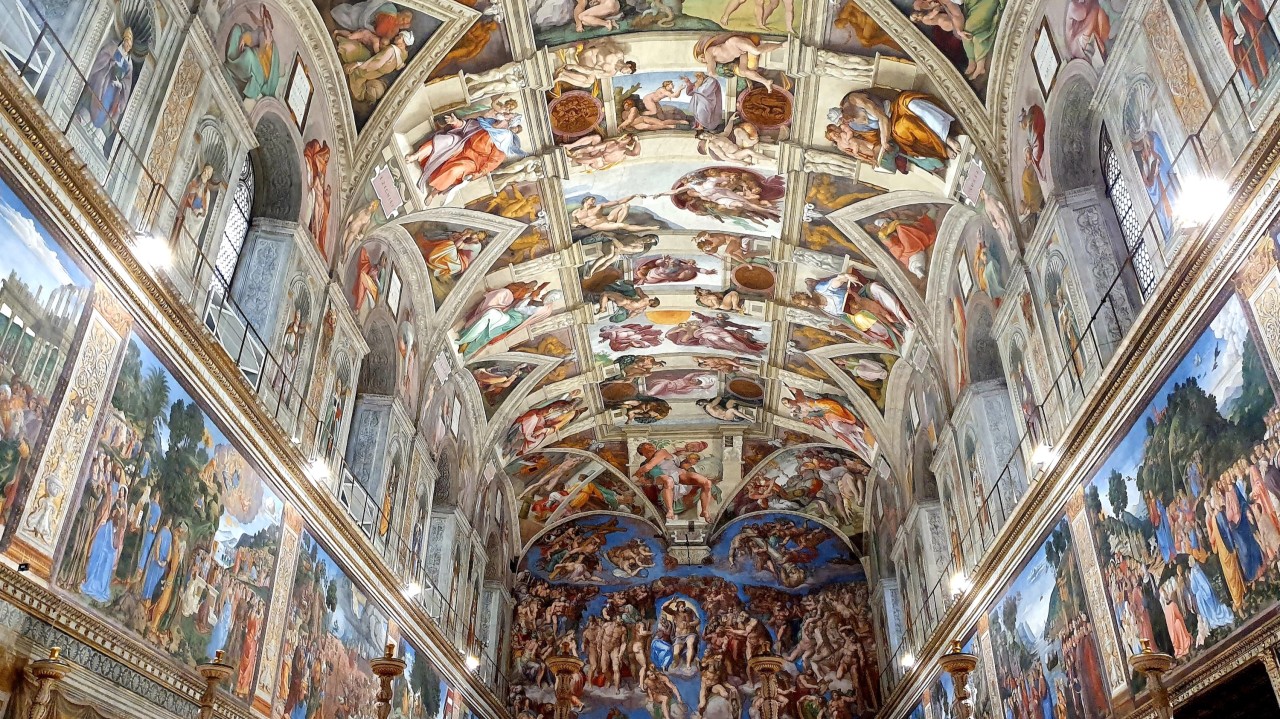
Florence, a city that had lost more than half its population, became the most beautiful city in the world. The commission that would eventually produce Ghiberti's bronze doors for the Baptistery of Florence Cathedral, known ever since as the Gates of Paradise, was issued in 1401. Leonardo, Michelangelo, Raphael. Not despite the devastation that preceded them, but in some complex, irresolvable way, because of it. The urgency of mortality, the collapse of old certainties, the desperate human need to assert that something could be made that would last: all of it concentrated into one of the most extraordinary explosions of genius in recorded history.
Darkness. Then Light. Without Exception
Post-war Britain in the 1940s and 1950s, rationing still in effect, cities still bearing bomb scars, produced the Festival of Britain, the National Health Service, and a generation of artists and architects who would define what modernity could look like when it chose to be humane rather than merely efficient. The neorealists in Italy turned poverty and devastation into luminous cinema. American abstract expressionism, born from the social ruptures of the Depression and the moral rupture of the war, made New York the new capital of world art with a violence and beauty that is still felt.
Then something else entirely. Out of the grey discipline of post-war rationing, out of a country that had spent a decade rebuilding itself brick by brick, came one of the most joyful creative explosions in modern history. The Beatles rewrote what popular music could be and in doing so rewrote what it meant to be young. The Rolling Stones brought danger. David Bowie, arriving at the decade's edge, brought something stranger and more enduring still: the idea that identity itself was an art form. Mary Quant put the mini skirt on Carnaby Street and changed the silhouette of the century. Terence Conran decided that ordinary people deserved beautiful things and built a design empire on that radical premise. Michael Caine walked into a cinema near you and made working-class ambition look like the most glamorous thing in the world. Britain, still bearing the scars of the Blitz, still counting the cost, became for a decade the cultural capital of the planet.
Then the late 1970s. Stagflation. Mass unemployment. The Cold War at its most rigid. Thatcher's Britain in the early grip of austerity. By the metrics that matter to markets, the conditions were uniformly grim.
Punk arrived like a detonation. What began as fury became, within years, one of the most fertile creative periods in British cultural history: post-punk, new wave, a generation of musicians, fashion designers, filmmakers, and artists who would export British culture to the world for the next 30 years. The Clash and Joy Division and Vivienne Westwood and the early work of directors and designers who are now canonical, all of it emerging from the grey, cash-strapped, politically exhausted Britain of 1978.
The 2008 financial crisis, too, produced its creative aftershock. Grime music coming of age in London. A resurgence of independent culture, independent publishing, independent food, independent fashion, as the collapse of institutional structures paradoxically freed a generation to build outside them. The startup culture that flourished in the years after 2008 was not despite the crash. It was shaped by it.
Why Darkness Makes Artists
Why does this happen? Why does civilisation, reliably, answer its worst chapters with its most beautiful ones?
The most compelling explanation has less to do with economics and more to do with psychology and necessity. Austerity strips away the inessential. Crisis clarifies. When the ordinary comforts of stability are removed and the future becomes genuinely illegible, human beings do not simply endure. They reach for something that stability, paradoxically, often suppresses: the need to make meaning.
Art, music, design, literature. These are not luxuries that flourish once safety has been restored. They are responses to the absence of safety. They are what emerges when external certainty collapses and internal resources are all that remain. The impulse to create is not a sign that things are fine. It is a sign that human beings are still human, still insisting, in the face of everything, that something can be made that was not there before.
There is also something to be said for the particular energy that grief and anger and disillusionment generate. The Lost Generation of writers, Fitzgerald, Hemingway, and Eliot; Sassoon, Owen, and Graves, all of them scarred by the First World War, produced a body of work that still defines how the twentieth century understands itself. They were not writing from comfort. They were writing from the specific wound of having seen a world destroyed and being obliged to live in what came after. That wound, in their hands, became literature.
The punk musicians of 1977 were not writing from prosperity. They were writing from fury. And fury, it turns out, is a remarkable creative fuel.
What Patient Capital Knows
There is a practical dimension to this that investors and allocators have historically underweighted, and that deserves more rigorous attention than it typically receives.
The periods of greatest cultural renewal in human history have also been periods of extraordinary long-term value creation. The collectors who bought Picasso during his Blue Period, when he was in his early twenties, living in poverty in Paris, painting grief that nobody wanted to buy, were not merely making an aesthetic judgement. They were making one of the shrewdest capital allocations of the twentieth century. The Europeans who understood what the Bauhaus was doing in 1919 acquired the foundational works of modern design at prices that bear no relationship to what they are worth today. The galleries that represented the abstract expressionists in the late 1940s, when the work was unfashionable and the artists were broke, built institutions that would define the art market for generations.
Constraint concentrates creativity. Concentrated creativity produces work of lasting value. Lasting value, in art, in companies, in ideas, is precisely what patient capital is designed to find.
The investors who have consistently missed this are the ones who wait for clarity before acting. The ones who confuse the absence of noise with the presence of opportunity. The most fertile creative and commercial moments in history have almost never announced themselves in advance. They have been recognised, by the few who recognised them at all, precisely in the period when everything else was still loudly, insistently wrong.
Somewhere, Right Now
The current moment, geopolitically fractured, economically uncertain, saturated with a quality of exhaustion that is difficult to precisely name, is not without precedent.
There is one force that makes this moment feel genuinely different from those that came before: artificial intelligence, arriving with a speed and scale that even its architects did not fully anticipate. It is reshaping industries, displacing certainties, and raising questions about human work, human creativity, and human identity that do not yet have settled answers. The anxiety is understandable. But history offers a countervailing observation. Every great technological leap has been accompanied not by the extinction of human creativity but by its intensification. The printing press did not end literature; it ignited the Renaissance. The industrial machine did not silence the poets; it produced the Romantics. Photography did not kill painting; it liberated it into Impressionism, Cubism, and abstraction. The machine age gave us the Bauhaus. And now, as AI redraws the boundaries of what machines can do, human beings are once again being pushed toward the one territory that has never been successfully automated: the need to make meaning, to feel something, to reach toward each other with beauty and say, wordlessly, I was here.
If the pattern holds, and the evidence suggests it does, then somewhere in the margins and studios and rehearsal rooms and late-night conversations of 2026, something is being made that will define the next decade. Something that will look, in hindsight, like the obvious response to this particular moment. Something that the people closest to it cannot yet fully see, because we are still inside it.
History does not offer comfort cheaply. It does not promise that the wars will end quickly, or that the markets will stabilise on schedule, or that the geopolitical chess game will resolve in favour of the reasonable. It offers something more austere, and perhaps more useful: the observation that human beings, in circumstances far worse than these, have consistently chosen to make something extraordinary.
They did not wait for the light to change.
They made the light themselves.
Food for Thought
A final thought to carry with you.
The Renaissance did not begin when the plague ended. It began while people were still dying.
Every era of extraordinary human creativity in recorded history has one thing in common: it was born not after the difficulty passed, but inside it. The artists, architects, musicians, and writers who defined their ages did not wait for permission, or safety, or certainty. They made things in the dark.
In a world that is asking you to be cautious, there is a quiet radicalism in choosing to create. In beauty. In ideas. In the patient, deliberate building of something that will outlast the moment.
History is not asking whether you will survive this period. It already knows the answer. It is asking what you will make of it.
Constellation is the investor editorial series of Nevv Capital. At Nevv, we curate legacies. Our strategy is to provide sophisticated investors the tools, insights, and access to participate intelligently in the alternative assets universe.*
DM or WhatsApp us to learn more.*
*For professional and accredited investors only.
Disclaimer: This edition of Constellation is shared for general information and educational purposes only. It does not constitute investment advice or a personal recommendation, nor should it be treated as an offer to sell, a solicitation to buy, or an invitation to engage in any transaction involving securities, funds, alternative assets, or any other financial instruments.
Past performance is not a reliable indicator of future results. The value of investments can fall as well as rise, and readers may not recover the amount originally invested. Before taking action, readers should seek independent financial, legal, tax, or other professional advice appropriate to their individual circumstances.
This publication does not include paid promotions, partnerships, or sponsored endorsements of any kind.